
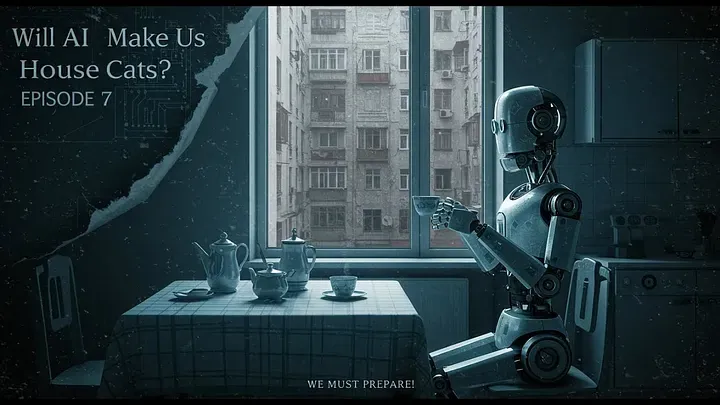
The question sounds dramatic: will AI make humans into house cats? Comfortable, dependent, shaped by systems we do not control?
The underlying question is more practical. What happens when AI agents can do real digital work autonomously, and the people using them stop thinking about what the AI is doing?
That is not a future scenario. It is an observable trend.
The upside: real leverage
AI agents can perform multi-step digital tasks with growing autonomy. A single person can now:
- Build and launch a web app in hours
- Do market research that used to require a team
- Generate, test, and iterate marketing copy at speeds that were impossible two years ago
- Automate support, data processing, and admin workflows
A motivated person with good judgment and basic AI fluency can prototype workflows that used to need five to ten people.
The downside: a new divide
The warning is not “machines will do everything.” It is that outcomes will split hard between two groups.
People who direct AI. They learn prompting, validation, workflow design, error correction. They use AI as a multiplier for their own judgment.
People who default to AI. They accept outputs without checking. They stop thinking through problems because the AI “handles it.”
When those systems fail, change, or produce wrong results, only the first group can adapt. Agency becomes an economic multiplier.
The deeper problems
Beyond jobs and productivity, three harder issues are coming:
Synthetic misinformation at scale. AI generates convincing text, images, audio, and video. Combined with agent-like distribution, misinformation becomes cheaper to produce and harder to catch.
Concentration of capability. If only large organizations control the most capable AI agents, the democratization story breaks down.
Dependency on algorithmic filters. As AI mediates more of our information, we see the world through algorithmic lenses. That shapes what we believe and what we think is possible.
Loss of meaningful challenge. If AI removes all friction from intellectual work, what happens to the satisfaction of getting better at something? What happens to the cognitive benefits of struggling through hard problems?
These are not productivity questions. They are design questions about how we want to live.
The rule that works
Use AI to build, solve, and ship. Do not use AI to disappear into optimized feeds or outsource decisions you should be making.
The difference between those two paths will decide whether AI expands human agency or shrinks it. Not in some abstract future. In the choices you make this week.
Based on research into autonomous AI agents, the divide between active orchestrators and passive consumers, and practical frameworks for maintaining agency.