
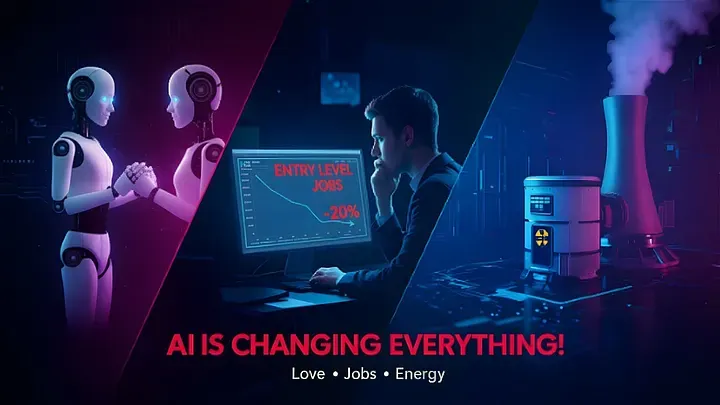
Most AI analysis picks one lane. Jobs. Or ethics. Or infrastructure.
This is a mistake. The real story is that three shifts are happening at once, and what happens next is where things get interesting.
1. Relationships are becoming computational
A growing number of young adults treat AI as a companion layer. Not everyone is replacing human relationships. But millions are testing emotional utility: support, validation, low-friction interaction, predictable responses.
AI companion apps grew over 300% year-over-year through 2025. Emotional support is now a top-5 AI use case on major platforms. Mental health professionals are encountering “AI dependency” as a clinical pattern for the first time.
This is not about AI romance going mainstream. It is about loneliness plus always-on digital access creating demand for synthetic emotional interfaces. That is a market signal, a public health signal, and a social design problem at the same time.
2. Entry-level work is getting hit first
AI replaces codified, repeatable cognitive tasks faster than it replaces judgment built from experience. Younger workers absorb the first impact.
The pattern:
- Companies do not slash wages right away
- They cut junior hiring instead
- Senior teams augmented by AI handle work that entry-level employees used to do
- Career ladders quietly lose their bottom runs
This is happening now in consulting, legal research, financial analysis, software development, and content production. The long-term problem: you cannot grow senior talent if there is nowhere for junior talent to learn.
3. AI is an infrastructure problem now
Training and running large models takes power, water, and land.
A single large training run can use as much electricity as 100+ U.S. homes in a year. Data center water consumption has become a municipal governance issue. Google, Microsoft, and Amazon are all investing in small modular nuclear reactors for AI workloads. Global data center power demand is on track to double by 2027.
AI is not just software anymore. It is an infrastructure consumer on the level of power plants and water systems.
These three shifts interact
Computational relationships change workforce expectations. Workforce displacement changes energy demand patterns. Energy constraints limit which AI capabilities can scale.
Most organizations plan for one of these. Almost nobody plans for all three.
What to do about it
If you lead a team, run a company, or shape policy, think in three layers:
Human behavior. How are your users, employees, or citizens changing because of AI?
Workforce design. Which roles are exposed in the next 18 months? What new roles are appearing? How are you building the bridge?
Infrastructure. What is your AI compute strategy? Where does the energy come from? What are the cost paths?
The future will not be shaped by people who use AI tools once. It will be shaped by people who redesign systems around what AI does second.
Based on a wide-ranging discussion covering AI companion technology, entry-level workforce displacement, and AI infrastructure energy demands.